
Most companies can tell you what you bought three years ago.
Ask what they promised you three weeks ago, and the answer can be harder to find.
McKinsey’s recent work on AI in customer experience argues that context should travel across channels and handoffs, rather than disappear between interactions.[1] I would judge that continuity by something specific: whether the company follows through on what it agreed to do.
I call this reciprocal memory. Alongside the customer’s purchase history and preferences, the record should preserve the company’s side of the relationship: what it promised, what remains unresolved and what needs to happen next.
Consider a failed delivery and a promised refund. On the next call, the customer should not have to prove that the refund was approved. The employee should be able to see the agreement and check whether the money was issued. An exception made during the first conversation should not disappear because a different team handles the second.
Keeping those commitments requires the company to remember itself.
When a forgotten promise triggers another call, the company pays for work it should not have created. Someone has to reconstruct the case, check the agreement and explain the delay. The customer has another reason to doubt whether the next assurance will mean anything.
There is a measurable cost here. In a 2019 example, McKinsey reported that a large US-based energy producer reduced repeat calls by 25% to 50% and saved $5 million to $10 million by addressing their underlying causes. That intervention covered several operational problems. It was not an AI-memory project.[2] The case establishes the value of reducing repeat work, not what a new memory system will earn.
Customer-effort research also links repeat contacts and repeated explanations with disloyalty.[3] Resolving the issue without forcing the customer to chase it is a better outcome than simply making the second call faster.
Reciprocal memory could also give management a clearer view of the company’s outstanding commitments. Refunds promised but not issued would sit alongside overdue callbacks and recovery actions that never reached completion.
AI could help assemble those commitments from notes and conversations into an operating backlog of what the company still owes. I would require each entry to link back to its source, with a named owner responsible for completion. The system’s interpretation of a conversation should not become an unquestioned instruction.
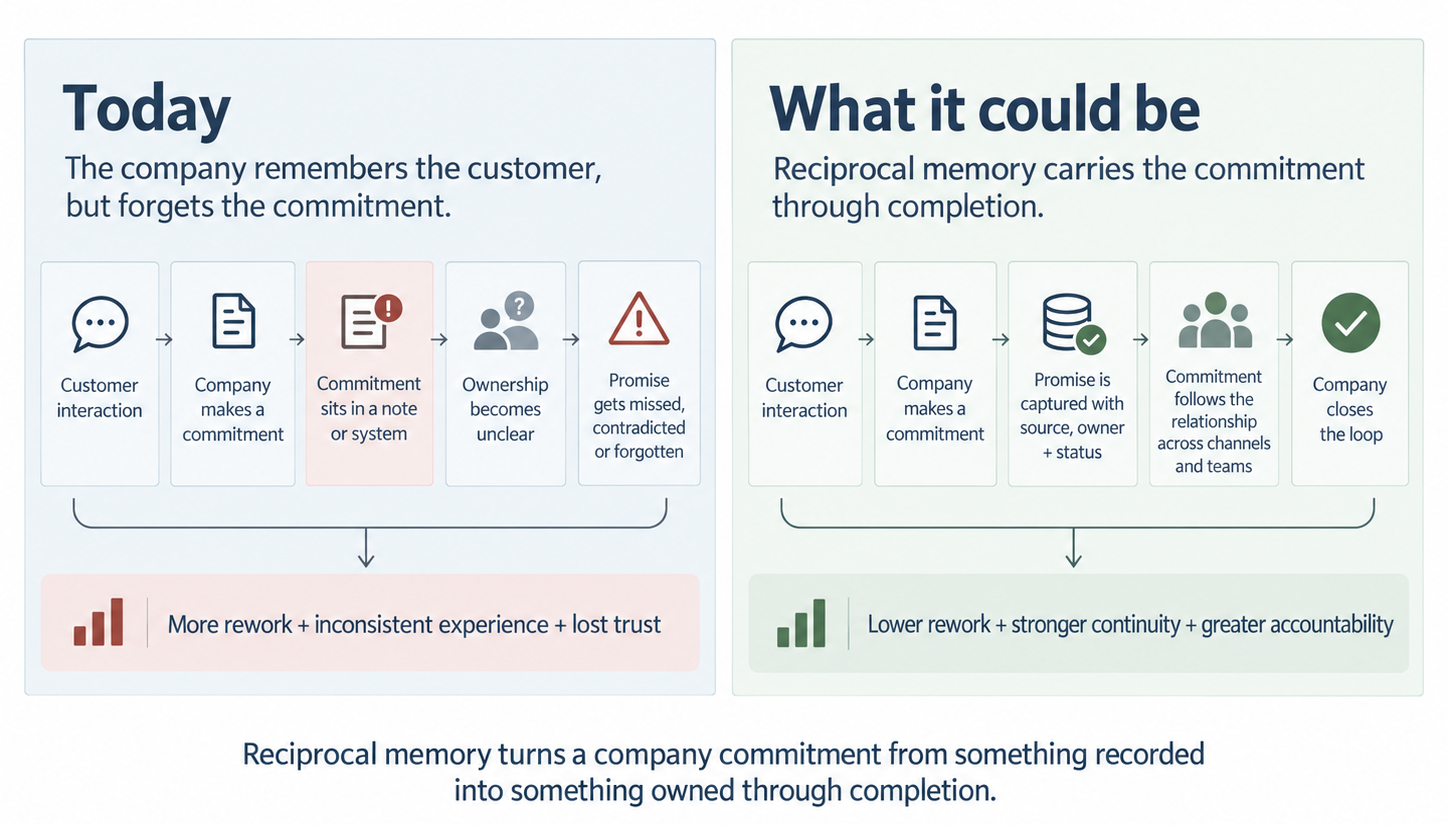
Read exhibit text
Today
The company remembers the customer, but forgets the commitment.
- Customer interaction
- Company makes a commitment
- Commitment sits in a note or system
- Ownership becomes unclear
- Promise gets missed, contradicted or forgotten
More rework + inconsistent experience + lost trust
What it could be
Reciprocal memory carries the commitment through completion.
- Customer interaction
- Company makes a commitment
- Promise is captured with source, owner + status
- Commitment follows the relationship across channels and teams
- Company closes the loop
Lower rework + stronger continuity + greater accountability
Reciprocal memory turns a company commitment from something recorded into something owned through completion.
The record may already exist. In that case, the problem is getting it to someone with the authority to act. Memory alone will not fix a process in which everyone can see the promise but nobody is responsible for keeping it.
There is also a limit to what a company should remember. A study forthcoming in the Journal of Retailing and Consumer Services found competing effects: displaying more AI memory could increase perceived convenience, while also making customers feel the agent had overstepped the relationship, undermining trust.[4] That is a reason to be selective about what the next interaction brings forward.
A refund promise has a clear purpose: getting the money back to the customer. An emotional detail disclosed during the complaint may have no useful place in the next conversation. Retaining it simply because the system can would be hard to defend.
Accuracy matters as much as restraint. If AI records a promise nobody made, or misses one that was, it creates another service problem. Source checks and a correction path belong in the design, not in the response to the first complaint. McKinsey makes a similar point, recommending that consequential agent actions be reversible and that humans have clear override points when the agent is wrong.[1]
Customers should have a way to challenge the record. The business also needs a clear purpose for retaining information and a decision about when it is no longer needed. Those choices belong with service leaders and their privacy colleagues before the system goes live.
Start with one recurring failure, such as promised refunds. Track commitments completed on time and the repeat contacts caused by missed ones. Measure the time spent reconstructing cases before and after the change. Compare the value of that reduction with the cost of the technology and ongoing review. Treat any retention improvement as something to test, rather than revenue already earned.
For the customer waiting on a refund, none of this needs to be visible. The company simply does what it said it would do.
There is a difference between a company remembering you and a company remembering what it owes you.